Central to Doug Aitken’s “100 YRS” exhibition at 303 Gallery is a new “Sonic Fountain,” in which water drips from 5 rods suspended from the ceiling, falling into a concrete crater dug out of the gallery floor. The flow of water itself is controlled so as to create specific rhythmic patterns that will morph, collapse and overlap in shifting combinations of speed and volume, lending the physical phenomenon the variable symphonic structure of song. The water itself appears milky white, as if imbued and chemically altered by its aural properties, a basic substance turned supernatural. The amplified sound of droplets conjures the arrhythmia of breathing, and along with the pool’s primordial glow, the fountain creates its own sonic system of tracking time. Click here to see and read more.
Showing posts with label video. Show all posts
Showing posts with label video. Show all posts
Friday, February 8, 2013

Tuesday, October 16, 2012
jose´ bowen . . .
Teaching Naked Preview
José Antonio Bowen
Dean of the Meadows School of the Arts,and Algur H. Meadows Chair and Professor of Music, at Southern Methodist University
The most important benefits to using technology occur outside of the classroom. Use technology for first exposure to material, student engagement, preparation between classes, new assignments and to free yourself from the need to “cover” all of the content in the classroom. This creates more class time for face-to-face (naked) interaction and discussion between faculty and students, which is the best way to stimulate the change in mental models that is real learning (and justify the higher price tag of our physical campus experience). The classroom of the future is a seminar, not a lecture hall. This
workshop is focused on student engagement to prepare for class.
Book
Teaching Naked: How Moving Technology Out of Your College Classroom Will Improve Student Learning (2012)www.teachingnaked.com
Saturday, September 15, 2012
charles w. cushman . . .
A LITTLE BIT MORE
As a photographer, are you a "witness to your time?" Click here to see and learn about Charles W. Cushman, an inspiring witness.
There's so much more to learn from the The Charles W. Cushman Photograph Collection, housed at Indiana University. Archival image researcher Rich Remsberg, whose voice you heard above, has an introductory essay. And historian Eric Sandweiss brings it to life in his book, The Day In Its Color, (Oxford University Press, 2012).
But the most helpful guide to these photos was left by Cushman himself. He took meticulous notes about each and every photograph, filling dozens of notebooks with details about where he was and when. So, for example, we know that the Golden Gate Bridge photo was taken on a cloudless day in September, 1938… and 1953 and 1954… and 1968. You get the point.

Although the bridge, as a recurring image, stays consistent over three decades, the things surrounding it don't. Cushman's cars change. So do his clothes. America evolves before our very eyes — if we're patient enough to wade through hundreds of images in chronological order. New railroads influence commerce, highways connect people and machines replace horses. Cushman saw it happening and, for whatever reason, felt compelled to document history as it unfolded. That's what separates him from the vacation photographer: Why else would someone photograph a smokestack outside of Chicago?
There's a tidy organization to Cushman's photos, but there's also a serendipity. Dig around the archives and you'll unearth lush landscapes, impressionistic florals and self-portraits that, with hindsight, we can describe as brooding.
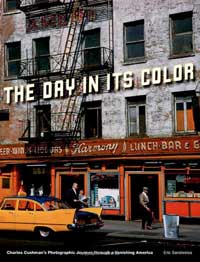
As Sandweiss explains, Cushman's photographs were mediated by his tumultuous marriage with Jean. He was born in the very small town of Poseyville, Indiana, but married into an established Chicago family. Jean was cousins with John Steinbeck, incidentally; and she came undone after her father's death. From then on, it seems, Cushman's photographs gave him a kind of therapy.
We do the same thing today. We put frames around moments to make sense of them — to make them last. Although these days, it's easy to create 14,500 images in an aggressive week of digital shooting. We capture everything — from birthdays to sunsets to what's for lunch. But Cushman provokes a question: Are we just making noise, or are we really processing the passage of time?
"He's a great reminder…" Remsberg says, "that photography is not a contest. … It's about being a witness to your times."
So: Are you a witness?
Monday, September 10, 2012
thomas demand . . .

A Sneak Peek at Thomas Demand’s Storm-Tossed Imagination
By KATHY RYAN
Three years ago, the German conceptual artist Thomas Demand saw a startling video on YouTube that captured the chaotic scene inside a cruise ship being tossed about by a storm in the South Pacific. Everything not bolted down — chairs, tables, bottles, cartons, people — could be seen sliding back and forth across the floor as the ship rocked violently. But where most viewers might have forwarded the link to their friends, Demand decided to recreate the scene, minus the people, entirely out of paper and cardboard, then film it.
Here, an exclusive clip from Demand’s film:
Demand has long been known for building and photographing realistic, life-size models of actual environments. The resulting pictures are the final works of art — so realistic that people often don’t realize they’re looking at paper constructions — while the sculptural models themselves are destroyed and never exhibited.
The “Pacific Sun” video (named after the cruise ship) consists of 2,400 still images all together. The animators took three and a half months to meticulously re-create every object’s path across the room. The resulting video — that’s a sneak peek above — can be seen starting this evening at theMatthew Marks Gallery at 523 West 24th Street in New York, with other new works by Demand.
This week, I spoke to Demand about how he works. Here are some edited highlights from our conversation:
Why are there no people in your images?
I think the imagination works better if you don’t have people, because if there are people, you look at it as an anecdote. If you have an empty space that in this case is animated and has lots of signs of life, it is actually like reading a novel or something. You basically create in your own mind what is happening or what the space represents, and for me, that is much more interesting.
A remarkable thing I have to say is when I started doing this, it was a slapstick-movie thing, and it was interesting and peculiar, and I thought it’s just absurd but also it has a certain beauty. Then the tsunami happened in Japan, and then the cruise ship hit the rock off the coast of northern Italy. It was no longer slapstick. The context in which the image would be seen changed throughout the making of the film.

Those disasters happened after you had begun?
I was in the middle of it when the tsunami happened. I hired people. I rented a studio in California. I had a whole workshop set up, building all these chairs and whatever else we needed. There were between 8 to 12 animators on set working 12-hour days for three and a half months. There were 55 chairs. The people we were working with on the project were unbelievable — fantastically dedicated. I was told there are only about 35 animators in L.A. We basically had 12 of those animators for three and a half months.

The animators do what, exactly?
In recent years, stop-motion animation has become very popular. “Fantastic Mr. Fox” is an example of this. People like the handcrafted quality of it. You can’t really fake it with C.G.I. I initially thought about doing it digitally, but in the end decided to do it with stop-motion animation because it is so beautiful. Everything was made of paper. They were really fragile objects. The fragility of the objects gives the scene its beauty. Plus, all the C.G.I. people I spoke to just said it would be too complicated to do virtually, and it will never look like the real thing, so we should really try to do it in animation.

One of the reasons why I moved to L.A. was because I thought it was kind of a stable climate, sunshine every day. It’s sunny, but what I didn’t have on my list of things — what I didn’t consider — were the earthquakes, the tiny little shakes of the earth every day. When we would start in the morning, we would always see a little change in the placement of the objects from the night before.

I didn’t realize there were so many tiny movements every day.
Every day something is moving. Like 1.2 on the Richter scale or something.
 Thomas Demand
Is that something filmmakers there are always dealing with?
I don’t know. Nobody seems to talk about it. If I say earthquake, everybody in L.A. rolls their eyes and says, Thank God it wasn’t the big one yet. For animation, it’s terrible because these objects are all moving a little fraction. It was really a disaster. It was funny as hell. That’s why we needed a lot of people — because we had to adjust all this. It’s so minimal you can’t really do anything about it, but that’s also quite charming in the end because everything is kind of vibrating.

Any movement, like a ketchup bottle falling off a table, the animators would have to imagine that over a stretch of a week or something, but it’s going to be only three seconds in the film, and it takes them a week to make it. You need imagination to know how it actually falls down and how all this is fitting together. We had scripts for every object, but that’s another very long story.

*****
Back in 1997, the magazine commissioned Demand to re-create a massage parlor for a special photo issue devoted to Times Square; more recently, to accompany a cover story in Nov. 2008 on executive power, he constructed a life-size version of the Oval Office.
Back in 1997, the magazine commissioned Demand to re-create a massage parlor for a special photo issue devoted to Times Square; more recently, to accompany a cover story in Nov. 2008 on executive power, he constructed a life-size version of the Oval Office.

Thursday, September 6, 2012
rafael lozano-hemmer . . .
Rafael Lozano- Hemmer
Voice Array
Sep 6 – Oct 13, 2012 bitforms gallery nyc
Sep 6 – Oct 13, 2012 bitforms gallery nyc
bitforms gallery is pleased to announce its fourth solo exhibition with Mexican-Canadian artist Rafael Lozano-
Hemmer. The exhibition features the United States premiere of two projects: Voice Array, a participatory
environment that debuted last Fall in Sydney, Australia, at the Museum of Contemporary Art; and Last Breath,
which was part of the 11th Bienal de la Habana. Concurrent with the New York exhibition, on September 20,
Lozano-Hemmer will also unveil Open Air, a new commission by the Association for Public Art in Philadelphia.
Since his emergence in the 1990s, Lozano-Hemmer has mixed the disparate fields of digital media, robotics,
medical science, performance art, and lived experience into interactive artworks. Probably best known for his
large-scale “Antimonuments”, which challenge traditional notions of site-specificity, he focuses on the idea of
creating relationship-specific work through connective interfaces. Often employing vanguard technologies,
many of his projects utilize robotics, custom software, projections, internet links, cell phones, sensors, LEDs,
cameras, and tracking systems.
The communal spaces that Lozano-Hemmer creates are an experiment in public authorship. Technology in his work activates seamless “encounters of art, self and the kinetic force of collective memory,” writes Claudia Arozqueta (Artforum.com, Jan 2012). As a conductor of this experience, he seduces the audience into participation, using tactile sensation, repetition and the simulated presence of an individual.
At the gallery entrance, Last Breath is a robotic installation that stores and circulates the breath of a person forever, between a bellows and a brown paper bag. The apparatus is automatically activated 10,000 times per day, the typical respiratory frequency for an adult at rest. With each breath the piece generates quiet sounds from the bellows, the motor and the crackling of the paper bag. The piece also sighs 158 times a day. For the exhibition in New York, the piece is a biometric portrait of Cuban singer Omara Portuondo. A short video of her recording her breath into the device is shown on a small screen mounted to the wall.
Filling the gallery’s far wall, Voice Array is a construction for vocal improvisation that uses blinking LEDs and a customized intercom system of audio playback and recording. Capturing hundreds of voices and translating each one into a series of light flashes, the piece stores a unique pattern as a loop in the first light of the array, until the next participant speaks into the intercom. Each new recording is pushed along its long horizontal band of LEDs, as sounds of the voices gradually accumulate. When the first voice reaches the other side of the piece, the participant’s phrase is once again released as sound, punctuated by the staggering pulsation of all the lights in tandem. The ever-changing voices stored by the piece play back through a directional speaker, during moments of less activity.
Click here to read and see more.
Tuesday, August 28, 2012
andy warhol . . .


Between 1964 and 1966, Warhol created almost five hundred of these film portraits of famous and anonymous visitors to his studio, including Salvador Dalí, Dennis Hopper and Edie Sedgwick. Warhol filmed his subjects using a stationary, Bolex camera loaded with 100-foot rolls of black and white 16mm film. Sitters were instructed to sit still for about three minutes, the length of time it took for the roll of film to run through the camera. He later projected the silent Screen Tests in slow motion, thereby extending their duration to four minutes and imbuing them with a dreamlike stillness. During the 1960s, these films were rarely shown in public, but were often shown at The Factory.
In a gallery reminiscent of Warhol’s Silver Factory studio, museum visitors are invited to create their own screen test utilizing a computer touch screen, a moveable backdrop, a specially modified vintage camera, and twin studio lights. Upon completion, the visitor’s screen test is transformed digitally from real time to slow motion and pushed to the Internet, where their work of art will be available on a custom webpage. The screen test can then be shared on various social media channels.
“With media so transformed in contemporary life, it is often difficult for visitors to imagine how things were done almost 50 years ago. This interactive experience offers the opportunity to gain insight into how Warhol created one of his most significant bodies of work by demonstrating the process by which he made these films. The visitors’ finished screen tests will reveal the subtle nuances that made Warhol’s films transcend their medium to become visual masterpieces,” stated Geralyn Huxley, curator of film & video.
“In a most Warholian gesture, we are riding the wave of innovation and new technologies in launching this fun and exciting interactive feature that will allow our guests to achieve their own 15 minutes of fame here at The Andy Warhol Museum. We are always striving to improve our visitor’s experiences at the museum, and this Screen Test Interactive project allows everyone to learn about Warhol’s process while making their own work of art that they can then share on various social media platforms with friends and Warhol fans around the world. It is our core mission to promote and share the work of Andy Warhol with our global audience, and I am thrilled to see what conversations emerge thanks to this cool new project,” stated Eric Shiner, director of The Warhol.
The Screen Test Interactive project was created by The Warhol team with help from Pittsburgh-based technology startup Interbots, and designer Michael Johnson and developer Evan Tahler.
Click here to see results.
Monday, August 20, 2012
art in the age of truthiness . . .
Art in the Age of Truthiness
One would think that reality would remain constant, but as we learn and develop, reality and our experiences of it changes with us. Now on view at Site Santa Fe, More Real? Art in the Age of Truthiness, bring together more than 25 international artists who question the stability of reality. For our look back into the DS Archives, we bring you the 2008 exhibition at the Hirshorn Museum, The Cinema Effect: Illusion, Reality, and the Moving Image.
The following article was originally published on August 19, 2008 by Catherine Wagley:
Curated by Anne Ellegood and Kristen Hileman, Realism includes work by nineteen diverse artists:Candice Breitz, Matthew Buckingham, Paul Chan, Ian Charlesworth, Phil Collins, Jeremy Deller, Kota Ezawa, Omer Fast, Pierre Huyghe, Runa Islam, Christian Jankowski, Isaac Julien, Michele Magema, Julian Rosefeldt, Corinna Schnitt, Mungo Thomson, Kerry Tribe, Francesco Vezzoli and Artur Zmijewski.
As the above video discusses, Realism highlights the cultural, historical savvy of today’s most innovative film artists, while also probing the unique technological capacity film has to question what’s “real.” The exhibition continues through September.
Tuesday, July 31, 2012
jack goldstein . . .
Jack Goldstein x 10,000” consists of thirty-plus years of work. The early films that put Goldstein on the map as a member of the Pictures group are there (including “The Jump,” 1978, and “MGM,” 1975), as are several immersive sculptures, text works, and records—not to mention the enormous, black-and-white paintings of the ‘80s and the paintings that followed.
Monday, July 23, 2012
michelle given . . .
Moving On is an installation that is contingent upon audience participation. The piece is comprised of a 16mm projector and a paper shredder plugged into a timer set to thirty seconds. A viewer must start the timer to see the old family movies, thereby committing themselves not only to thirty seconds of footage, but also to the permanent destruction of thirty precious seconds of the same film, someone else’s memories, which glitter in the light as they are spat out of the shredder. The nostalgia traditionally associated with viewing old family films is undermined by the shredder’s jarring sound. I am intrigued by causality and responsibility; those that choose to fully experience the piece are also complicit in the destruction of its key component. The title can refer to the act of forgetting or destroying the past and/or memories, as well as the unromantic advancement of audio-visual technology.
To see more work by Michelle Given click here.
To see more work by Michelle Given click here.
Monday, July 9, 2012
walter plotnick . . .
Walter is a photo-based artist who lives and works in the Philadelphia area. He received his MFA from University of the Arts and BFA from Tyler School of Art. Currently, he is an instructor in the Fine Arts Department at Penn State Abington, as well as Montgomery County Community College. He recently completed a film, featuring a Fine Art Department colleague and a classroom of art students engaged in an end-of-year assignment that Walter wanted to document in a creative way. It's a testament to the power of collaborative artistic expression and how art inspires. Read more . . .
Sunday, May 27, 2012
Thursday, May 3, 2012
kraftwerk . . .
Over eight consecutive nights, MoMA presents a chronological exploration of the sonic and visual experiments of Kraftwerk with a live presentation of their complete repertoire in the Museum's Marron Atrium.


Saturday, April 28, 2012
Thursday, April 26, 2012
Wednesday, April 18, 2012
paul graham . . .
Paul Graham from white tube on Vimeo.
The House of Photography, Hamburg, Germany
24 SEPTEMBER 2010 – 9 JANUARY 2011
watch more Videos on this website: whitetube.de
find whitetube on facebook.com/whitetube
subscribe to vimeo.com/channels/whitetube
For more information about Paul Graham visit:
paulgrahamarchive.com
pacemacgill.com
24 SEPTEMBER 2010 – 9 JANUARY 2011
watch more Videos on this website: whitetube.de
find whitetube on facebook.com/whitetube
subscribe to vimeo.com/channels/whitetube
For more information about Paul Graham visit:
paulgrahamarchive.com
pacemacgill.com