Central to Doug Aitken’s “100 YRS” exhibition at 303 Gallery is a new “Sonic Fountain,” in which water drips from 5 rods suspended from the ceiling, falling into a concrete crater dug out of the gallery floor. The flow of water itself is controlled so as to create specific rhythmic patterns that will morph, collapse and overlap in shifting combinations of speed and volume, lending the physical phenomenon the variable symphonic structure of song. The water itself appears milky white, as if imbued and chemically altered by its aural properties, a basic substance turned supernatural. The amplified sound of droplets conjures the arrhythmia of breathing, and along with the pool’s primordial glow, the fountain creates its own sonic system of tracking time. Click here to see and read more.
Showing posts with label absolute frame. Show all posts
Showing posts with label absolute frame. Show all posts
Friday, February 8, 2013

Saturday, September 15, 2012
process and frames . . .
Nope.

Nope.
One of my favorite occurrences in the Art world is when an artist acknowledges the viewers’ expectations, and actively denies them. In a time seemingly ruled by art with the highest sensational value, I can’t help but root for the heroic and/or obstinate people unabashedly making minimalist conceptual art that allows for none of the easily digestible catharses one might hope for. This is not to say that the work is underdeveloped or shallow; I think a closed door holds as much if not more mystery, potential narrative and freedom to expand upon than an open door through which we can clearly see everything. It is the same “closed door” potential that completely saturates Edits, the current exhibition of Jason Kraus’s work at Jessica Silverman Gallery.
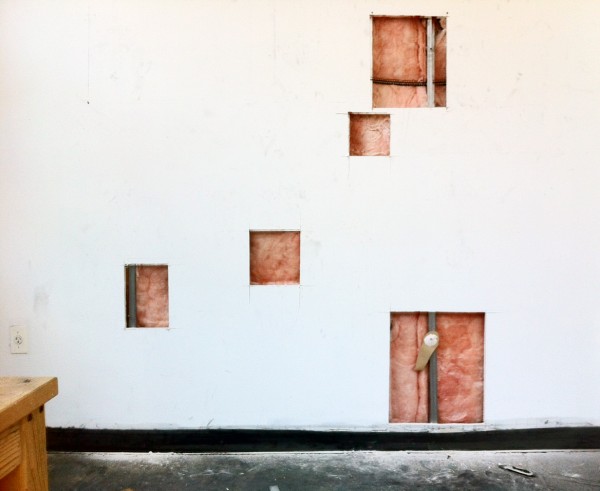
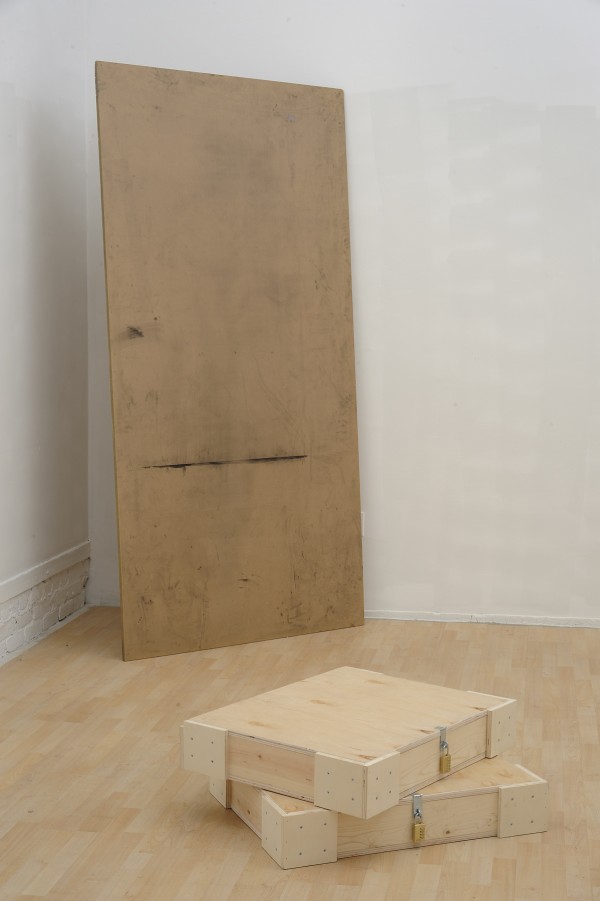
Inside the gallery, the installation is seductively minimal and almost entirely monochromatic. Extracted pieces of Kraus’s studio walls hang mounted in frames, the dry-wall marked with the charcoal smudges and traces of the artist’s process. A large-format, b&w photograph titled An Empty Space documents the void created by hundreds of drawings made on Kraus’s studio wall, where the charcoal that escaped the paper’s surface marks off the edges of the absent pieces of paper. The Serra-esque drawing board learning in a corner reinforces the trompe l’oeil effect of An Empty Space; the two objects acting as the signifier and signified of something that is much more abstract than the expected tangibility of a sign, such as a chair.
The real star of the show, however, is the pairing of two wooden crates locked with combination locks, and a framed envelope that Kraus mailed to Jessica Silverman, the gallery owner. Completely unassuming, the crates (probably) hold all the drawings that we see the traces of in the surrounding works. The corresponding envelope contains the combination that opens the locks on the crates. This is a simple enough concept: there is a lock, and there is a combination that opens the lock. The punch-line is that the two pieces may never be acquired by the same person, ensuring that the drawings will never be revealed. Now, I have to admit that the inner-brat in me loves this restriction. As I see it, basically Kraus is saying, “Oh, you wanted to see the art we’re talking about? Too bad.” Of course, the work absolutely should not be pigeon-holed in the sort of school-yard teasing with which I indulgently associate it. The dialog between the works in the show also heavily references the performative act of making art, emphasizing that the process can hold just as much importance as the final product.
Edits is not a show for anyone looking for an easy entry point or sensational reward from the viewing experience. It is not obvious, and demands that viewers release their typically tight grasp on what part of the art-making process we think should be presented. It is also not overly pretentious; the work does not pretend to be something that it’s not. Instead, Kraus expands the aura of the show through omission, and shows the viewer, “This is what I want you to think about.”
Edits is on view at Jessica Silverman Gallery from 7 September–20 October, 2012.
Wednesday, September 5, 2012
timo klos . . .
I'm not sure how this series of photographs pertains to "frames", but I just feel like somehow it relates?
September 5, 2012
September 5, 2012
TIMO KLOS’S BUS STOPS TO NOWHERE


There are only five photos in Timo Klos’s series “To Mark Time.” In each photo, there is a bus stop. There are no people in the photos—neither at the bus stops nor anywhere else. There are no buses, either, which is perhaps not so surprising when you notice that none of the bus stops face a trafficked road. The absence of buses is even less surprising when you learn that the bus stops are fake. Constructed outside of nursing homes in Germany, these bus stops are not transit points. They are destinations. Residents suffering from dementia wait at the stops for buses that will never come. They wait and they talk and they remember, until they are escorted back inside, or return of their volition, having forgotten where it is they won’t be going that day.
Read more http://www.newyorker.com/online/blogs/photobooth#ixzz25e4CFFSr
andy warhol . . .
Andy Warhol's '15 minutes' of fame are not up yet


(CNN) -- Iconic Pop artist Andy Warhol is often quoted for his statement, "In the future, everybody will be world-famous for 15 minutes." Twenty-five years after his death, his influence on contemporary art has well surpassed the 15-minute mark.
Campbell Soup Company is the latest entity to honor his legacy.
This week, 1.2 million limited-edition cans of condensed tomato soup with labels inspired by his Pop art go on sale. The specially designed Campbell's soup cans pay tribute to his lively color palette, using orange, blue, pink and teal to spruce up the familiar design. The labels commemorate the 50th anniversary of Warhol's famed art piece "32 Campbell's Soup Cans."
Some of Warhol's famous quotes are printed on the Campbell's cans, too, including "Pop art is for everyone." This quote is significant as his wide-ranging body of work helped "blur the boundaries between high and low culture," said Michael Hermann, director of licensing at The Andy Warhol Foundation. Warhol appealed to a massive audience from all walks of life, he said.
Warhol's humble roots stem from a working-class neighborhood in Pittsburgh, where he was born in 1928. As an adult, he moved to New York City, where he set up a studio and built his fame and fortune. His enormous body of work included multiple mediums and featured subjects ranging from celebrities such as Marilyn Monroe to simple, everyday items such as a banana.
"I believe Warhol's popularity is certainly due in part to his uncanny ability to present the familiar from unexpected perspectives through visually and conceptually impactful works of art. However, it seems his influence today comes as much from his biography as someone who embodied the American dream and celebrated creativity and individuality," said Hermann.
When once asked why he painted the soup cans, Warhol noted, "I used to have the same (Campbell's soup) lunch every day for 20 years."
He was also known to say, "I was looking for something that was the essence of nothing, and that was it." His unique style of artistic expression and world view is credited for launching his career and the Pop art movement.
Art collectors have paid millions of dollars for some of Warhol's pieces, but shoppers at Target, where the limited-edition soup cans are on sale, will have to shell out only 75 cents for a 10.75-ounce can.
"What continues to amaze me is that 25 years after his death, Warhol continues to have a profound influence on our culture," said Hermann. "For me, this is a true testament to his genius, and I can only imagine that Andy would have loved shopping at Target for this soup."
Campbell Soup Company never commissioned Warhol to paint the original soup cans. Former president and CEO of the company, William Beverly Murphy, initially had reservations about Warhol's work 50 years ago, and Campbell took a "wait and see approach" before fully supporting him. Now, the company takes great pride in its association with the iconic artist.
"Thanks to Andy Warhol's inspired paintings, Campbell's soup will always be linked to the Pop art movement," Ed Carolan, vice president and general manager, of Campbell North America stated in a news release to CNN.
"It is only fitting that 50 years later, we celebrate the enduring legacy of these two American icons by coming full circle and bringing his art back to the Campbell's soup cans that provided him with inspiration," noted Hermann.
The Campbell's soup labels were produced under license from The Andy Warhol Foundation, a not-for-profit corporation that promotes the visual arts. Some revenue generated from the project will fund the foundation's endowment, from which it distributes grants that support the "creation, presentation and documentation of contemporary visual art," according to Hermann.
In addition to the soup cans, Campbell has partnered with The Metropolitan Museum of Art in New York as a sponsor of the educational programs associated with an exhibit paying tribute to Warhol. The show, "Regarding Warhol: Sixty Artists, Fifty Years,"opens September 18. Warhol's piece "Big Campbell's Soup Can, 19¢" is included in the exhibition, along with some of his other famous works.
Monday, July 23, 2012
michelle given . . .
Moving On is an installation that is contingent upon audience participation. The piece is comprised of a 16mm projector and a paper shredder plugged into a timer set to thirty seconds. A viewer must start the timer to see the old family movies, thereby committing themselves not only to thirty seconds of footage, but also to the permanent destruction of thirty precious seconds of the same film, someone else’s memories, which glitter in the light as they are spat out of the shredder. The nostalgia traditionally associated with viewing old family films is undermined by the shredder’s jarring sound. I am intrigued by causality and responsibility; those that choose to fully experience the piece are also complicit in the destruction of its key component. The title can refer to the act of forgetting or destroying the past and/or memories, as well as the unromantic advancement of audio-visual technology.
To see more work by Michelle Given click here.
To see more work by Michelle Given click here.
Monday, March 14, 2011
wolfgang tillmans . . .
For his new exhibition at Regen Projects, Wolfgang Tillmans' color prints and large inkjet prints are unframed and taped or clipped to the wall in a primarily linear, non-heirarchical installation.

Tuesday, February 1, 2011
new way of presenting art . . .
LONDON (REUTERS).- Google aims to bring the world's great art galleries into the home with a new website that offers virtual tours using Street View technology, the ability to build private collections and ultra-high resolution images. While most big galleries have been busy making their works accessible online for years, experts told a launch at London's Tate Britain gallery on Tuesday that Google's site was looking to take the online art experience to a new level. "It could be the game changer," said Julian Raby of the Freer Gallery of Art, part of the Smithsonian in Washington DC, which is one of 17 galleries taking part in the project. Nelson Mattos, VP Engineering at Google, said the Art Project site would allow children from Latin America, India and Africa, who were unlikely to see the originals, to come close to the experience on the internet. By: Mike Collett-White

Saturday, November 13, 2010
marco breuer . . .
In his 2010 exhibition at Von Lintel Gallery in New York the altered gallery, painted with a band of chalkboard black, refers to the photographic darkroom as well as the classroom. Employing a range of tools such as drywall snap lines, stencils, and pounce bags, Marco Breuer uses chalk to add notations, measurements, diagrams, and marks. The improvisatory nature of the installation is intended to highlight Breuer's relationship to the darkroom as a place where ideas and images are not merely executed, but generated and considered.


Sunday, November 7, 2010
walead beshty . . .
Listen to Walead Beshty talk about his photographs and installation work in the 2008 Whitney Biennial. Think about the connection between the concepts he is dealing with and how he presents the work.
jack pierson . . .
These images in Jack Pierson's exhibition Go There Now and Take This with You (June 2010) at Bortolami Gallery in New York have been folded and then unfolded and pinned like posters directly to the wall.


Thursday, October 21, 2010
joseph cornell . . .

Joseph Cornell, Medici Princess

Joseph Cornell, Medici Prince

Joseph Cornell, Medici Boy

Joseph Cornell, Penny Arcade Portrait of Lauren Bacall


Wednesday, October 20, 2010
marcel broodthaers . . .
The work of Marcel Broodthaers titled Section Cinema has been re-created on site at Marian Goodman Gallery in New York. The installation becomes an "extended frame" for the photographs which are a part of it. The viewer enters the installation (frame) and becomes immersed 'within' it. In addition, some of the photographs which are part of the installation have "immediate frames" which the viewer stands on the 'outside' of. Click here to see and read more.

