Welcome to fortytwofifty. This is where I will be posting useful photo information I come across during the semester, things like links to photographers' websites, recommended readings, inspiring quotes, and much more.

I hope you will check in often. Look, learn, and enjoy!


Showing posts with label artist's frames. Show all posts

Tuesday, January 29, 2013

xerox book . . .


In December of 1968, Seth Siegelaub and Jack Wendler published The XEROX BOOK, an exhibition produced entirely in book form. The project included seven contributing conceptual artists: Carl Andre, Robert Barry, Joseph Kosuth, Sol LeWitt, Douglas Huebler, Robert Morris and Lawrence Weiner.
The Kadist Art Foundation in San Francisco recently spoke to Jack Wendler about The XEROX BOOK offering a unique glimpse into the history of this celebrated project.


Saturday, September 15, 2012

process and frames . . .


Nope.


Nope.
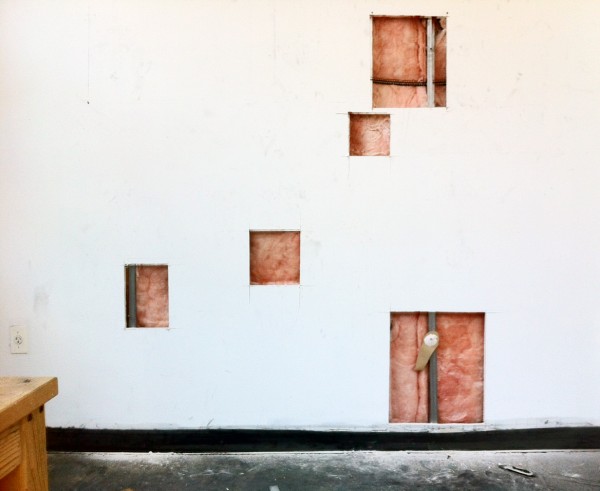
One of my favorite occurrences in the Art world is when an artist acknowledges the viewers’ expectations, and actively denies them. In a time seemingly ruled by art with the highest sensational value, I can’t help but root for the heroic and/or obstinate people unabashedly making minimalist conceptual art that allows for none of the easily digestible catharses one might hope for. This is not to say that the work is underdeveloped or shallow; I think a closed door holds as much if not more mystery, potential narrative and freedom to expand upon than an open door through which we can clearly see everything. It is the same “closed door” potential that completely saturates Edits, the current exhibition of Jason Kraus’s work at Jessica Silverman Gallery.
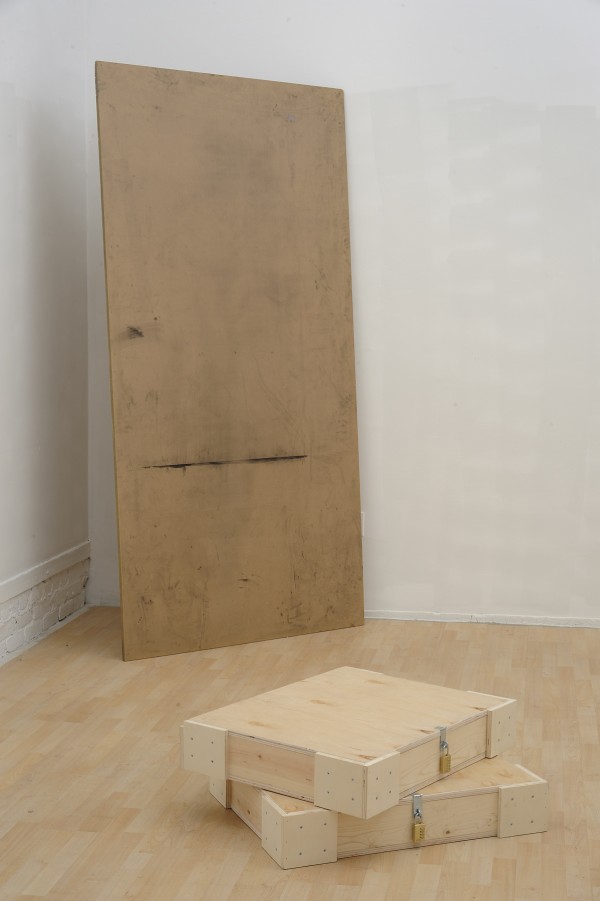
Inside the gallery, the installation is seductively minimal and almost entirely monochromatic. Extracted pieces of Kraus’s studio walls hang mounted in frames, the dry-wall marked with the charcoal smudges and traces of the artist’s process. A large-format, b&w photograph titled An Empty Space documents the void created by hundreds of drawings made on Kraus’s studio wall, where the charcoal that escaped the paper’s surface marks off the edges of the absent pieces of paper. The Serra-esque drawing board learning in a corner reinforces the trompe l’oeil effect of An Empty Space; the two objects acting as the signifier and signified of something that is much more abstract than the expected tangibility of a sign, such as a chair.
The real star of the show, however, is the pairing of two wooden crates locked with combination locks, and a framed envelope that Kraus mailed to Jessica Silverman, the gallery owner. Completely unassuming, the crates (probably) hold all the drawings that we see the traces of in the surrounding works. The corresponding envelope contains the combination that opens the locks on the crates. This is a simple enough concept: there is a lock, and there is a combination that opens the lock. The punch-line is that the two pieces may never be acquired by the same person, ensuring that the drawings will never be revealed. Now, I have to admit that the inner-brat in me loves this restriction. As I see it, basically Kraus is saying, “Oh, you wanted to see the art we’re talking about? Too bad.” Of course, the work absolutely should not be pigeon-holed in the sort of school-yard teasing with which I indulgently associate it. The dialog between the works in the show also heavily references the performative act of making art, emphasizing that the process can hold just as much importance as the final product.
Edits is not a show for anyone looking for an easy entry point or sensational reward from the viewing experience. It is not obvious, and demands that viewers release their typically tight grasp on what part of the art-making process we think should be presented. It is also not overly pretentious; the work does not pretend to be something that it’s not. Instead, Kraus expands the aura of the show through omission, and shows the viewer, “This is what I want you to think about.”
Edits is on view at Jessica Silverman Gallery from 7 September­­–20 October, 2012.

Saturday, September 8, 2012

lu zhengyuan . . .


Eli Klein Fine Art is pleased to present half-truth, a solo exhibition of new work by Lu Zhengyuan. 
Lu Zhengyuan’s collection of works entitled half-truth uses different media to explore the deceptive nature of viewer perception. Working in sculpture, painting, photography, and installation, the artist analyzes the dichotomy of “real” and “fake,” and the manner in which such an assessment shapes the viewer’s appreciation of an object. With pieces such as the light installation “Red Green,” where words conflict with the colors in which they appear, Lu Zhengyuan also examines the relationship between sensory perception of an object and cognitive understanding of its meaning.


Lu Zhengyuan, Artificial Flower Series - One is Broken, 2012  
Oil on canvas in resin frame, 27 x 34 3/4 inches (68.5 x 88 cm)


Lu Zhengyuan, The Artist's Left Eye, 2012  
Oil on canvas in resin frame, 15 1/8 x 15 1/8 inches (38 x 38 cm)

Lu Zhengyuan, Life Trilogy, 2012  
Oil on canvas in resin frame, 27 x 34 7/8 inches (68.5 x 88.5 cm)


Lu Zhengyuan, Lie, 2007  
Photography installation, 67 x 59 inches (170 x 150 cm) each
Using playful techniques to create optical illusions within his pieces, Lu Zhengyuan presents a clever twist on the concepts of real and fake, one that may require viewers to take a second look at the work before them. In “Lie,” the artist renders arrangements of fake flowers with meticulous detail. Through his visible effort to recreate exact copies of these bouquets, Lu Zhengyuan turns an otherwise ordinary object into an extraordinary one, giving it increased value simply through his manner of representation.
Despite his mischievous manipulation of viewer perception, the message of Lu Zhengyuan’s work is optimistic; the artist demonstrates for the viewer new methods to understand and appreciate an object. Here, “fake” is not viewed in a pejorative light, as the skill and ingenuity required to render a “fake” object bestow it with a significance all its own. “Moon in the Room,” encapsulates the value inherent within Lu Zhengyuan’s fake objects. In order to view the moon in a city where smog prevents the real moon from being visible, the artist developed a means to capture the various qualities of a moonlit sky, thereby recreating the moon’s effect.
Lu Zhengyuan was born in Dalian, China in 1982, and received his Master of Fine Arts from the Central Academy of Fine Arts in Beijing, where he is currently a professor. Recent solo exhibitions include “Refle-Ction: Lu Zhengyuan,” White Box Museum of Art, Beijing, China (2012) and “84 Days, 84 Works of Art,” Ullens Center for Contemporary Art, Beijing, China (2010). 
half-truth will be on view at Eli Klein Fine Art from September 5th through October 21st, 2012. The artist will be present for the opening reception on Wednesday, September 5thfrom 6 – 8 PM. For further information, please contact the gallery at info@ekfineart.comor at +1 (212) 255-4388