Welcome to fortytwofifty. This is where I will be posting useful photo information I come across during the semester, things like links to photographers' websites, recommended readings, inspiring quotes, and much more.
I hope you will check in often. Look, learn, and enjoy!
Dean of the Meadows School of the Arts, and Algur H. Meadows Chair and Professor of Music, at Southern Methodist University The most important benefits to using technology occur outside of the classroom. Use technology for first exposure to material, student engagement, preparation between classes, new assignments and to free yourself from the need to “cover” all of the content in the classroom. This creates more class time for face-to-face (naked) interaction and discussion between faculty and students, which is the best way to stimulate the change in mental models that is real learning (and justify the higher price tag of our physical campus experience). The classroom of the future is a seminar, not a lecture hall. This workshop is focused on student engagement to prepare for class.
Book
Teaching Naked: How Moving Technology Out of Your College Classroom Will Improve Student Learning (2012)
The New Yorker has been around since 1925, but didn’t publish a single photograph for its first forty-six years. That changed in 1971, when a tiny photo of a bonnet-clad piglet made an appearance on page 64 of the issue of January 30th. Twenty-one more years passed until the magazine took on its first staff photographer: Richard Avedon.
“When Tina Brown brought him to The New Yorker, in 1992,” Adam Gopnik wrote in his 2004 Postscript on Avedon, “she was rupturing a long-standing taboo against photography, and even those who loved his work must have had their doubts. But his photographs, in their epigrammatic compression of a whole subject into a single black-and-white image, were New Yorker profiles in miniature, and within weeks it was as if he had always graced these pages.”
Two years ago, The New Yorker’s embrace of photography expanded to include Photo Booth—the blog you’re looking at now—and today we’re introducing a new design for Photo Booth, including a new fullscreen slide-show function. (Just click on the red arrows in the upper right corner.) In celebration of our renovation, here’s a look back at Avedon’s portraits of writers commissioned by The New Yorker, including the portrait of Salman Rushdie that appears in our current issue, alongside Rushdie’s account of his life after the fatwa. “A portrait is not a likeness.” Avedon wrote in his book “In the American West.” “There is no such thing as inaccuracy in a photograph. All photographs are accurate. None of them is the truth.”
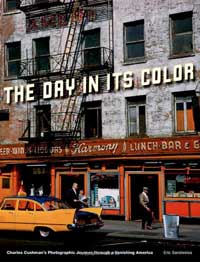
As a photographer, are you a "witness to your time?" Click here to see and learn about Charles W. Cushman, an inspiring witness.
There's so much more to learn from the The Charles W. Cushman Photograph Collection, housed at Indiana University. Archival image researcher Rich Remsberg, whose voice you heard above, has an introductory essay. And historian Eric Sandweiss brings it to life in his book, The Day In Its Color, (Oxford University Press, 2012).
But the most helpful guide to these photos was left by Cushman himself. He took meticulous notes about each and every photograph, filling dozens of notebooks with details about where he was and when. So, for example, we know that the Golden Gate Bridge photo was taken on a cloudless day in September, 1938… and 1953 and 1954… and 1968. You get the point.
Although the bridge, as a recurring image, stays consistent over three decades, the things surrounding it don't. Cushman's cars change. So do his clothes. America evolves before our very eyes — if we're patient enough to wade through hundreds of images in chronological order. New railroads influence commerce, highways connect people and machines replace horses. Cushman saw it happening and, for whatever reason, felt compelled to document history as it unfolded. That's what separates him from the vacation photographer: Why else would someone photograph a smokestack outside of Chicago?
There's a tidy organization to Cushman's photos, but there's also a serendipity. Dig around the archives and you'll unearth lush landscapes, impressionistic florals and self-portraits that, with hindsight, we can describe as brooding.
As Sandweiss explains, Cushman's photographs were mediated by his tumultuous marriage with Jean. He was born in the very small town of Poseyville, Indiana, but married into an established Chicago family. Jean was cousins with John Steinbeck, incidentally; and she came undone after her father's death. From then on, it seems, Cushman's photographs gave him a kind of therapy.
We do the same thing today. We put frames around moments to make sense of them — to make them last. Although these days, it's easy to create 14,500 images in an aggressive week of digital shooting. We capture everything — from birthdays to sunsets to what's for lunch. But Cushman provokes a question: Are we just making noise, or are we really processing the passage of time?
"He's a great reminder…" Remsberg says, "that photography is not a contest. … It's about being a witness to your times."
One of my favorite occurrences in the Art world is when an artist acknowledges the viewers’ expectations, and actively denies them. In a time seemingly ruled by art with the highest sensational value, I can’t help but root for the heroic and/or obstinate people unabashedly making minimalist conceptual art that allows for none of the easily digestible catharses one might hope for. This is not to say that the work is underdeveloped or shallow; I think a closed door holds as much if not more mystery, potential narrative and freedom to expand upon than an open door through which we can clearly see everything. It is the same “closed door” potential that completely saturates Edits, the current exhibition of Jason Kraus’s work at Jessica Silverman Gallery.
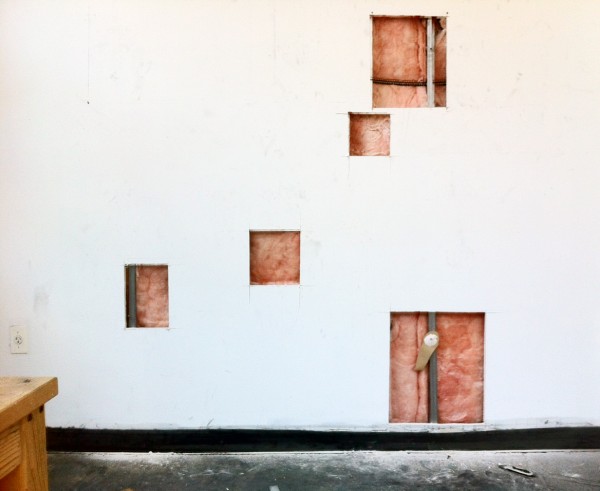
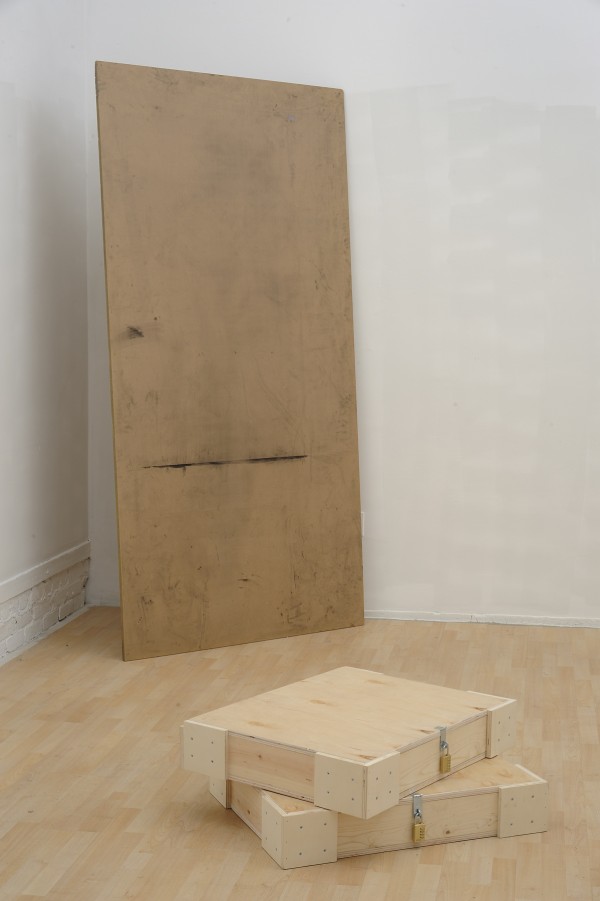
Inside the gallery, the installation is seductively minimal and almost entirely monochromatic. Extracted pieces of Kraus’s studio walls hang mounted in frames, the dry-wall marked with the charcoal smudges and traces of the artist’s process. A large-format, b&w photograph titled An Empty Space documents the void created by hundreds of drawings made on Kraus’s studio wall, where the charcoal that escaped the paper’s surface marks off the edges of the absent pieces of paper. The Serra-esque drawing board learning in a corner reinforces the trompe l’oeil effect of An Empty Space; the two objects acting as the signifier and signified of something that is much more abstract than the expected tangibility of a sign, such as a chair.
The real star of the show, however, is the pairing of two wooden crates locked with combination locks, and a framed envelope that Kraus mailed to Jessica Silverman, the gallery owner. Completely unassuming, the crates (probably) hold all the drawings that we see the traces of in the surrounding works. The corresponding envelope contains the combination that opens the locks on the crates. This is a simple enough concept: there is a lock, and there is a combination that opens the lock. The punch-line is that the two pieces may never be acquired by the same person, ensuring that the drawings will never be revealed. Now, I have to admit that the inner-brat in me loves this restriction. As I see it, basically Kraus is saying, “Oh, you wanted to see the art we’re talking about? Too bad.” Of course, the work absolutely should not be pigeon-holed in the sort of school-yard teasing with which I indulgently associate it. The dialog between the works in the show also heavily references the performative act of making art, emphasizing that the process can hold just as much importance as the final product.
Edits is not a show for anyone looking for an easy entry point or sensational reward from the viewing experience. It is not obvious, and demands that viewers release their typically tight grasp on what part of the art-making process we think should be presented. It is also not overly pretentious; the work does not pretend to be something that it’s not. Instead, Kraus expands the aura of the show through omission, and shows the viewer, “This is what I want you to think about.”
Edits is on view at Jessica Silverman Gallery from 7 September–20 October, 2012.
No photographs here, but very visually compelling presentation of dots! maybe think photographs??
LUDWIGSHAFEN.- Visitors adhere circular stickers in a room installation at the exhibition “Dot.Systems - from Pointillism to Pixel” by Japanese artist Yayoi Kusama at the Wilhelm-Hack Museum in Ludwigshafen, Germany. Tthe exhibition which will run until Sept. 30, the room was absolutely white. The installation was created by all the visitors who attached the colorful stickers. AP Photo/dapd, Torsten Silz.
Three years ago, the German conceptual artist Thomas Demand saw a startling video on YouTube that captured the chaotic scene inside a cruise ship being tossed about by a storm in the South Pacific. Everything not bolted down — chairs, tables, bottles, cartons, people — could be seen sliding back and forth across the floor as the ship rocked violently. But where most viewers might have forwarded the link to their friends, Demand decided to recreate the scene, minus the people, entirely out of paper and cardboard, then film it.
Here, an exclusive clip from Demand’s film:
Demand has long been known for building and photographing realistic, life-size models of actual environments. The resulting pictures are the final works of art — so realistic that people often don’t realize they’re looking at paper constructions — while the sculptural models themselves are destroyed and never exhibited.
The “Pacific Sun” video (named after the cruise ship) consists of 2,400 still images all together. The animators took three and a half months to meticulously re-create every object’s path across the room. The resulting video — that’s a sneak peek above — can be seen starting this evening at theMatthew Marks Gallery at 523 West 24th Street in New York, with other new works by Demand.
This week, I spoke to Demand about how he works. Here are some edited highlights from our conversation:
Why are there no people in your images?
I think the imagination works better if you don’t have people, because if there are people, you look at it as an anecdote. If you have an empty space that in this case is animated and has lots of signs of life, it is actually like reading a novel or something. You basically create in your own mind what is happening or what the space represents, and for me, that is much more interesting.
A remarkable thing I have to say is when I started doing this, it was a slapstick-movie thing, and it was interesting and peculiar, and I thought it’s just absurd but also it has a certain beauty. Then the tsunami happened in Japan, and then the cruise ship hit the rock off the coast of northern Italy. It was no longer slapstick. The context in which the image would be seen changed throughout the making of the film.
Thomas Demand
Those disasters happened after you had begun?
I was in the middle of it when the tsunami happened. I hired people. I rented a studio in California. I had a whole workshop set up, building all these chairs and whatever else we needed. There were between 8 to 12 animators on set working 12-hour days for three and a half months. There were 55 chairs. The people we were working with on the project were unbelievable — fantastically dedicated. I was told there are only about 35 animators in L.A. We basically had 12 of those animators for three and a half months.
Thomas Demand
The animators do what, exactly?
In recent years, stop-motion animation has become very popular. “Fantastic Mr. Fox” is an example of this. People like the handcrafted quality of it. You can’t really fake it with C.G.I. I initially thought about doing it digitally, but in the end decided to do it with stop-motion animation because it is so beautiful. Everything was made of paper. They were really fragile objects. The fragility of the objects gives the scene its beauty. Plus, all the C.G.I. people I spoke to just said it would be too complicated to do virtually, and it will never look like the real thing, so we should really try to do it in animation.
Thomas Demand
One of the reasons why I moved to L.A. was because I thought it was kind of a stable climate, sunshine every day. It’s sunny, but what I didn’t have on my list of things — what I didn’t consider — were the earthquakes, the tiny little shakes of the earth every day. When we would start in the morning, we would always see a little change in the placement of the objects from the night before.
Thomas Demand
I didn’t realize there were so many tiny movements every day.
Every day something is moving. Like 1.2 on the Richter scale or something.
Thomas Demand
Is that something filmmakers there are always dealing with?
I don’t know. Nobody seems to talk about it. If I say earthquake, everybody in L.A. rolls their eyes and says, Thank God it wasn’t the big one yet. For animation, it’s terrible because these objects are all moving a little fraction. It was really a disaster. It was funny as hell. That’s why we needed a lot of people — because we had to adjust all this. It’s so minimal you can’t really do anything about it, but that’s also quite charming in the end because everything is kind of vibrating.
Thomas Demand
Any movement, like a ketchup bottle falling off a table, the animators would have to imagine that over a stretch of a week or something, but it’s going to be only three seconds in the film, and it takes them a week to make it. You need imagination to know how it actually falls down and how all this is fitting together. We had scripts for every object, but that’s another very long story.
Thomas Demand
***** Back in 1997, the magazine commissioned Demand to re-create a massage parlor for a special photo issue devoted to Times Square; more recently, to accompany a cover story in Nov. 2008 on executive power, he constructed a life-size version of the Oval Office.
Thomas Demand for The New York TimesDemand’s re-creation of a massage parlor from our Times Square issue from 1997.
Bruce Rich has watched 25,341 videos from the lynda.com video library. Thought of in a different way, he has consumed 52 full days worth of knowledge. It’s like watching eight hours of educational TV every Friday, Saturday, and Sunday for a complete year. It’s like watching the complete Star Wars saga ninety-five times.
Bruce Rich has completed 508 courses, and has the certificates to prove it.
The amount of time Rich spends watching educational videos may seem outlandish. But if you’ve read Outliers, you are familiar with Malcolm Gladwell’s rule that 10,000 hours of practice leads to mastery of a topic—a competency. Most of us have worked on something for 10,000 hours, so Rich is unique only in that he’s mastered two and one-half competencies. Think of it like a master’s degree.
“I very seldom watch TV,” says Rich. “I get up early and do training instead. My son says I’m off in my own little world.”
During the daylight hours, Rich is the president of Hot Off The Press, Inc., a commercial printer located in Des Plaines, Illinois. He’s worked in the printing industry for 40 years, starting with letterpress, moving to offset, and now supplying brochures, catalogs, and banners. His next goal is supplying web sites and mobile app development for his customers.
“I have a customer with 100,000 products on his web site,” says Rich. “I made some suggestions, and now he wants me to take it over. I need to learn more before I take that on, but lynda.com shows you everything you need.”
Rich uses a couple of tricks to speed up his learning. Because he’s paying close attention while watching, he speeds the playback to double-speed, then slows it down when he needs to practice an example. He uses the exercise files and transcripts to preview and review the material.
“Deke moves fast,” says Rich. “Pausing the playback is crucial. When you’re doing the exercises, your hand is getting trained.”
Bruce Rich enjoys learning, and his customers benefit from his newfound knowledge. Rich used information from Deke McClelland and Chris Orwig to improve a product shot for Stewarts Coffee in Chicago. The company was thrilled with the results: a coffee can without hotspots.
“Customers see the certificates on the wall, and when they realize I’ve taken a course in something, they ask me for help,” says Rich. “I use the videos on lynda.com to preview software before I buy it, and use it to research customer recommendations.”
What’s next? Rich swears he’ll be taking a break after he finishes the series onAdobe Creative Suite 6. But then…
“A friend wants to write iPhone apps,” he says. “I’ll need to learn some Cocoa andObjective-C.”
Perhaps Rich should start clearing another room for the next 500 certificates.
Eli Klein Fine Art is pleased to present half-truth, a solo exhibition of new work by Lu Zhengyuan.
Lu Zhengyuan’s collection of works entitled half-truth uses different media to explore the deceptive nature of viewer perception. Working in sculpture, painting, photography, and installation, the artist analyzes the dichotomy of “real” and “fake,” and the manner in which such an assessment shapes the viewer’s appreciation of an object. With pieces such as the light installation “Red Green,” where words conflict with the colors in which they appear, Lu Zhengyuan also examines the relationship between sensory perception of an object and cognitive understanding of its meaning.
Lu Zhengyuan, Artificial Flower Series - One is Broken, 2012
Oil on canvas in resin frame, 27 x 34 3/4 inches (68.5 x 88 cm)
Lu Zhengyuan, The Artist's Left Eye, 2012
Oil on canvas in resin frame, 15 1/8 x 15 1/8 inches (38 x 38 cm)
Lu Zhengyuan, Life Trilogy, 2012
Oil on canvas in resin frame, 27 x 34 7/8 inches (68.5 x 88.5 cm)
Lu Zhengyuan, Lie, 2007
Photography installation, 67 x 59 inches (170 x 150 cm) each
Using playful techniques to create optical illusions within his pieces, Lu Zhengyuan presents a clever twist on the concepts of real and fake, one that may require viewers to take a second look at the work before them. In “Lie,” the artist renders arrangements of fake flowers with meticulous detail. Through his visible effort to recreate exact copies of these bouquets, Lu Zhengyuan turns an otherwise ordinary object into an extraordinary one, giving it increased value simply through his manner of representation.
Despite his mischievous manipulation of viewer perception, the message of Lu Zhengyuan’s work is optimistic; the artist demonstrates for the viewer new methods to understand and appreciate an object. Here, “fake” is not viewed in a pejorative light, as the skill and ingenuity required to render a “fake” object bestow it with a significance all its own. “Moon in the Room,” encapsulates the value inherent within Lu Zhengyuan’s fake objects. In order to view the moon in a city where smog prevents the real moon from being visible, the artist developed a means to capture the various qualities of a moonlit sky, thereby recreating the moon’s effect.
Lu Zhengyuan was born in Dalian, China in 1982, and received his Master of Fine Arts from the Central Academy of Fine Arts in Beijing, where he is currently a professor. Recent solo exhibitions include “Refle-Ction: Lu Zhengyuan,” White Box Museum of Art, Beijing, China (2012) and “84 Days, 84 Works of Art,” Ullens Center for Contemporary Art, Beijing, China (2010).
half-truth will be on view at Eli Klein Fine Art from September 5th through October 21st, 2012. The artist will be present for the opening reception on Wednesday, September 5thfrom 6 – 8 PM. For further information, please contact the gallery at info@ekfineart.comor at +1 (212) 255-4388.
bitforms gallery is pleased to announce its fourth solo exhibition with Mexican-Canadian artist Rafael Lozano-
Hemmer. The exhibition features the United States premiere of two projects: Voice Array, a participatory
environment that debuted last Fall in Sydney, Australia, at the Museum of Contemporary Art; and Last Breath,
which was part of the 11th Bienal de la Habana. Concurrent with the New York exhibition, on September 20,
Lozano-Hemmer will also unveil Open Air, a new commission by the Association for Public Art in Philadelphia.
Since his emergence in the 1990s, Lozano-Hemmer has mixed the disparate fields of digital media, robotics,
medical science, performance art, and lived experience into interactive artworks. Probably best known for his
large-scale “Antimonuments”, which challenge traditional notions of site-specificity, he focuses on the idea of
creating relationship-specific work through connective interfaces. Often employing vanguard technologies,
many of his projects utilize robotics, custom software, projections, internet links, cell phones, sensors, LEDs,
cameras, and tracking systems.
The communal spaces that Lozano-Hemmer creates are an experiment in public authorship. Technology in his
work activates seamless “encounters of art, self and the kinetic force of collective memory,” writes Claudia
Arozqueta (Artforum.com, Jan 2012). As a conductor of this experience, he seduces the audience into
participation, using tactile sensation, repetition and the simulated presence of an individual.
At the gallery entrance, Last Breath is a robotic installation that stores and circulates the breath of a person
forever, between a bellows and a brown paper bag. The apparatus is automatically activated 10,000 times per
day, the typical respiratory frequency for an adult at rest. With each breath the piece generates quiet sounds
from the bellows, the motor and the crackling of the paper bag. The piece also sighs 158 times a day. For the
exhibition in New York, the piece is a biometric portrait of Cuban singer Omara Portuondo. A short video of her
recording her breath into the device is shown on a small screen mounted to the wall.
Filling the gallery’s far wall, Voice Array is a construction for vocal improvisation that uses blinking LEDs and a
customized intercom system of audio playback and recording. Capturing hundreds of voices and translating
each one into a series of light flashes, the piece stores a unique pattern as a loop in the first light of the array,
until the next participant speaks into the intercom. Each new recording is pushed along its long horizontal band
of LEDs, as sounds of the voices gradually accumulate. When the first voice reaches the other side of the
piece, the participant’s phrase is once again released as sound, punctuated by the staggering pulsation of all
the lights in tandem. The ever-changing voices stored by the piece play back through a directional speaker,
during moments of less activity. Click here to read and see more.
There are only five photos inTimo Klos’s series “To Mark Time.” In each photo, there is a bus stop. There are no people in the photos—neither at the bus stops nor anywhere else. There are no buses, either, which is perhaps not so surprising when you notice that none of the bus stops face a trafficked road. The absence of buses is even less surprising when you learn that the bus stops are fake. Constructed outside of nursing homes in Germany, these bus stops are not transit points. They are destinations. Residents suffering from dementia wait at the stops for buses that will never come. They wait and they talk and they remember, until they are escorted back inside, or return of their volition, having forgotten where it is they won’t be going that day.
(CNN) -- Iconic Pop artist Andy Warhol is often quoted for his statement, "In the future, everybody will be world-famous for 15 minutes." Twenty-five years after his death, his influence on contemporary art has well surpassed the 15-minute mark.
This week, 1.2 million limited-edition cans of condensed tomato soup with labels inspired by his Pop art go on sale. The specially designed Campbell's soup cans pay tribute to his lively color palette, using orange, blue, pink and teal to spruce up the familiar design. The labels commemorate the 50th anniversary of Warhol's famed art piece "32 Campbell's Soup Cans."
Some of Warhol's famous quotes are printed on the Campbell's cans, too, including "Pop art is for everyone." This quote is significant as his wide-ranging body of work helped "blur the boundaries between high and low culture," said Michael Hermann, director of licensing at The Andy Warhol Foundation. Warhol appealed to a massive audience from all walks of life, he said.
Warhol's humble roots stem from a working-class neighborhood in Pittsburgh, where he was born in 1928. As an adult, he moved to New York City, where he set up a studio and built his fame and fortune. His enormous body of work included multiple mediums and featured subjects ranging from celebrities such as Marilyn Monroe to simple, everyday items such as a banana.
"I believe Warhol's popularity is certainly due in part to his uncanny ability to present the familiar from unexpected perspectives through visually and conceptually impactful works of art. However, it seems his influence today comes as much from his biography as someone who embodied the American dream and celebrated creativity and individuality," said Hermann.
When once asked why he painted the soup cans, Warhol noted, "I used to have the same (Campbell's soup) lunch every day for 20 years."
He was also known to say, "I was looking for something that was the essence of nothing, and that was it." His unique style of artistic expression and world view is credited for launching his career and the Pop art movement.
Art collectors have paid millions of dollars for some of Warhol's pieces, but shoppers at Target, where the limited-edition soup cans are on sale, will have to shell out only 75 cents for a 10.75-ounce can.
"What continues to amaze me is that 25 years after his death, Warhol continues to have a profound influence on our culture," said Hermann. "For me, this is a true testament to his genius, and I can only imagine that Andy would have loved shopping at Target for this soup."
Campbell Soup Company never commissioned Warhol to paint the original soup cans. Former president and CEO of the company, William Beverly Murphy, initially had reservations about Warhol's work 50 years ago, and Campbell took a "wait and see approach" before fully supporting him. Now, the company takes great pride in its association with the iconic artist.
"Thanks to Andy Warhol's inspired paintings, Campbell's soup will always be linked to the Pop art movement," Ed Carolan, vice president and general manager, of Campbell North America stated in a news release to CNN.
"It is only fitting that 50 years later, we celebrate the enduring legacy of these two American icons by coming full circle and bringing his art back to the Campbell's soup cans that provided him with inspiration," noted Hermann.
The Campbell's soup labels were produced under license from The Andy Warhol Foundation, a not-for-profit corporation that promotes the visual arts. Some revenue generated from the project will fund the foundation's endowment, from which it distributes grants that support the "creation, presentation and documentation of contemporary visual art," according to Hermann.
In addition to the soup cans, Campbell has partnered with The Metropolitan Museum of Art in New York as a sponsor of the educational programs associated with an exhibit paying tribute to Warhol. The show, "Regarding Warhol: Sixty Artists, Fifty Years,"opens September 18. Warhol's piece "Big Campbell's Soup Can, 19¢" is included in the exhibition, along with some of his other famous works.
London exhibition recalls "the good old days of analogue photography"
Cyrus Mahboubian poses with his works of art.
LONDON.-Cyrus Mahboubian announced his second one-man show in London, to be held at the iconic venue The Troubadour on 5th and 6th September.
In the artist's own words, PHOTOWORKS is "a celebration of the magic of analogue photography" with every work in the exhibition made on classic photographic film.
The title PHOTOWORKS is a reference to the artist's belief that analogue photographs are true works of art, requiring technical know-how in order to balance light correctly and an eye for composition that doesn't rely on digital post-production.
A key component of the exhibition is Polaroid. What LIFE magazine described in 1972 as a "magic camera" was developed and improved constantly in the decades that followed and at the peak of its popularity in the 1990s an estimated 120 million packs of film were being produced annually.
Mahboubian calls Polaroid film, which was discontinued in 2008, "the antidote to the digital age of photography", claiming that the singularity of the pictures make them inherently special.
PHOTOWORKS will also include key examples of one-off Polaroid enlargements that Mahboubian makes using digital technology. According to the artist, embracing digital techniques was a way to continue working with his beloved images after the film disappeared from shelves.
Born in 1986 in London, Cyrus Mahboubian has been focused on photography since 2006 when he began experimenting with 35mm film and a vintage Nikon as a student at the University of Bristol.
Cyrus’s creativity is driven by a constant awareness of how quickly time passes. Always on the lookout for beauty, in daily journeys and chance encounters, his photography has evolved to become a diaristic record of his life—a way to preserve memories of fleeting moments.


 in the upper right corner.) In celebration of our renovation, here’s a look back at Avedon’s portraits of writers commissioned by The New Yorker, including the portrait of Salman Rushdie that appears in our current issue, alongside Rushdie’s