Welcome to fortytwofifty. This is where I will be posting useful photo information I come across during the semester, things like links to photographers' websites, recommended readings, inspiring quotes, and much more.

I hope you will check in often. Look, learn, and enjoy!


Tuesday, April 2, 2013

penelope umbrico . . .


The field of photography is constantly changing. What constitutes a "photographer" or a "photograph" has always been redefined by technological innovations. In the last two decades, the digital revolution and the Internet have enabled us to quickly develop new photographic processes, rapidly altering our definition of photography. One might even say that the present state of photography is similar to that of the time of its invention, when the form's emerging cultural significance swiftly expanded as a result of technological innovations. "The Photographic Universe: A Conference" reflects on this current moment, with the pervasive digitalization of the medium and its speedy permeation into contemporary life. Prominent thinkers and practitioners from a variety of artistic, scientific, cultural, and sociopolitical backgrounds discuss their role in the growing the field of photography, evaluate its increasingly blurry relationship between art and life, and speculate how photographic images will continue to change the way we see our world.

For more information, visit http://photographicuniverse.parsons.edu

Friday, February 8, 2013

doug aitken . . .

Central to Doug Aitken’s “100 YRS” exhibition at 303 Gallery is a new “Sonic Fountain,” in which water drips from 5 rods suspended from the ceiling, falling into a concrete crater dug out of the gallery floor. The flow of water itself is controlled so as to create specific rhythmic patterns that will morph, collapse and overlap in shifting combinations of speed and volume, lending the physical phenomenon the variable symphonic structure of song. The water itself appears milky white, as if imbued and chemically altered by its aural properties, a basic substance turned supernatural. The amplified sound of droplets conjures the arrhythmia of breathing, and along with the pool’s primordial glow, the fountain creates its own sonic system of tracking time. Click here to see and read more.

Tuesday, January 29, 2013

xerox book . . .


In December of 1968, Seth Siegelaub and Jack Wendler published The XEROX BOOK, an exhibition produced entirely in book form. The project included seven contributing conceptual artists: Carl Andre, Robert Barry, Joseph Kosuth, Sol LeWitt, Douglas Huebler, Robert Morris and Lawrence Weiner.
The Kadist Art Foundation in San Francisco recently spoke to Jack Wendler about The XEROX BOOK offering a unique glimpse into the history of this celebrated project.


Tuesday, October 16, 2012

jose´ bowen . . .


Teaching Naked Preview


José Antonio Bowen
Dean of the Meadows School of the Arts,
and Algur H. Meadows Chair and Professor of Music, at Southern Methodist University

The most important benefits to using technology occur outside of the classroom. Use technology for first exposure to material, student engagement, preparation between classes, new assignments and to free yourself from the need to “cover” all of the content in the classroom. This creates more class time for face-to-face (naked) interaction and discussion between faculty and students, which is the best way to stimulate the change in mental models that is real learning (and justify the higher price tag of our physical campus experience). The classroom of the future is a seminar, not a lecture hall. This
workshop is focused on student engagement to prepare for class.


Book
Teaching Naked: How Moving Technology Out of Your College Classroom Will Improve Student Learning (2012)


www.teachingnaked.com

Saturday, September 15, 2012

richard avedon . . .


The New Yorker magazine as frame . . .

 John Bayley and Iris Murdoch in London, December 1, 1995. For a Life and Letters piece by Ian Hamilton.

Salman Rushdie in London, September 26, 1994.


Toni Morrison in 2003. For a Profile by Hilton Als
.
The New Yorker has been around since 1925, but didn’t publish a single photograph for its first forty-six years. That changed in 1971, when a tiny photo of a bonnet-clad piglet made an appearance on page 64 of the issue of January 30th. Twenty-one more years passed until the magazine took on its first staff photographer: Richard Avedon.
“When Tina Brown brought him to The New Yorker, in 1992,” Adam Gopnik wrote in his 2004 Postscript on Avedon, “she was rupturing a long-standing taboo against photography, and even those who loved his work must have had their doubts. But his photographs, in their epigrammatic compression of a whole subject into a single black-and-white image, were New Yorker profiles in miniature, and within weeks it was as if he had always graced these pages.”
Two years ago, The New Yorkers embrace of photography expanded to include Photo Booth—the blog you’re looking at now—and today we’re introducing a new design for Photo Booth, including a new fullscreen slide-show function. (Just click on the red arrows arrows3.jpg in the upper right corner.) In celebration of our renovation, here’s a look back at Avedon’s portraits of writers commissioned by The New Yorker, including the portrait of Salman Rushdie that appears in our current issue, alongside Rushdie’s account of his life after the fatwa. “A portrait is not a likeness.” Avedon wrote in his book “In the American West.” “There is no such thing as inaccuracy in a photograph. All photographs are accurate. None of them is the truth.”


Read more http://www.newyorker.com/online/blogs/photobooth#ixzz26ZI4xyfn

charles w. cushman . . .


A LITTLE BIT MORE


As a photographer, are you a "witness to your time?" Click here to see and learn about Charles W. Cushman, an inspiring witness.

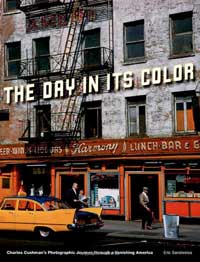
There's so much more to learn from the The Charles W. Cushman Photograph Collection, housed at Indiana University. Archival image researcher Rich Remsberg, whose voice you heard above, has an introductory essay. And historian Eric Sandweiss brings it to life in his book, The Day In Its Color, (Oxford University Press, 2012).
But the most helpful guide to these photos was left by Cushman himself. He took meticulous notes about each and every photograph, filling dozens of notebooks with details about where he was and when. So, for example, we know that the Golden Gate Bridge photo was taken on a cloudless day in September, 1938… and 1953 and 1954… and 1968. You get the point.
Although the bridge, as a recurring image, stays consistent over three decades, the things surrounding it don't. Cushman's cars change. So do his clothes. America evolves before our very eyes — if we're patient enough to wade through hundreds of images in chronological order. New railroads influence commerce, highways connect people and machines replace horses. Cushman saw it happening and, for whatever reason, felt compelled to document history as it unfolded. That's what separates him from the vacation photographer: Why else would someone photograph a smokestack outside of Chicago?
There's a tidy organization to Cushman's photos, but there's also a serendipity. Dig around the archives and you'll unearth lush landscapes, impressionistic florals and self-portraits that, with hindsight, we can describe as brooding.
As Sandweiss explains, Cushman's photographs were mediated by his tumultuous marriage with Jean. He was born in the very small town of Poseyville, Indiana, but married into an established Chicago family. Jean was cousins with John Steinbeck, incidentally; and she came undone after her father's death. From then on, it seems, Cushman's photographs gave him a kind of therapy.
We do the same thing today. We put frames around moments to make sense of them — to make them last. Although these days, it's easy to create 14,500 images in an aggressive week of digital shooting. We capture everything — from birthdays to sunsets to what's for lunch. But Cushman provokes a question: Are we just making noise, or are we really processing the passage of time?
"He's a great reminder…" Remsberg says, "that photography is not a contest. … It's about being a witness to your times."
So: Are you a witness?

process and frames . . .


Nope.


Nope.
One of my favorite occurrences in the Art world is when an artist acknowledges the viewers’ expectations, and actively denies them. In a time seemingly ruled by art with the highest sensational value, I can’t help but root for the heroic and/or obstinate people unabashedly making minimalist conceptual art that allows for none of the easily digestible catharses one might hope for. This is not to say that the work is underdeveloped or shallow; I think a closed door holds as much if not more mystery, potential narrative and freedom to expand upon than an open door through which we can clearly see everything. It is the same “closed door” potential that completely saturates Edits, the current exhibition of Jason Kraus’s work at Jessica Silverman Gallery.
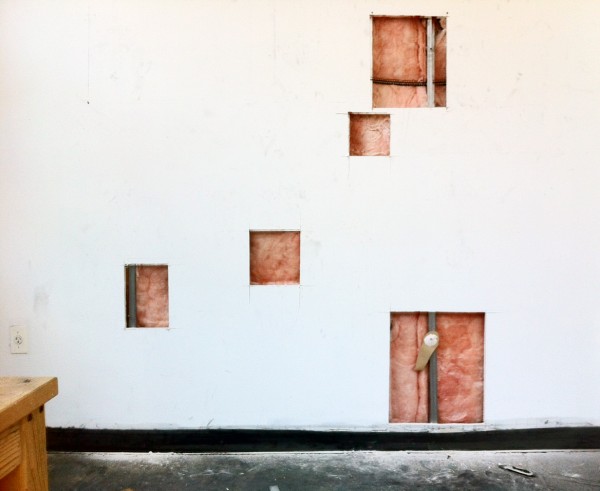
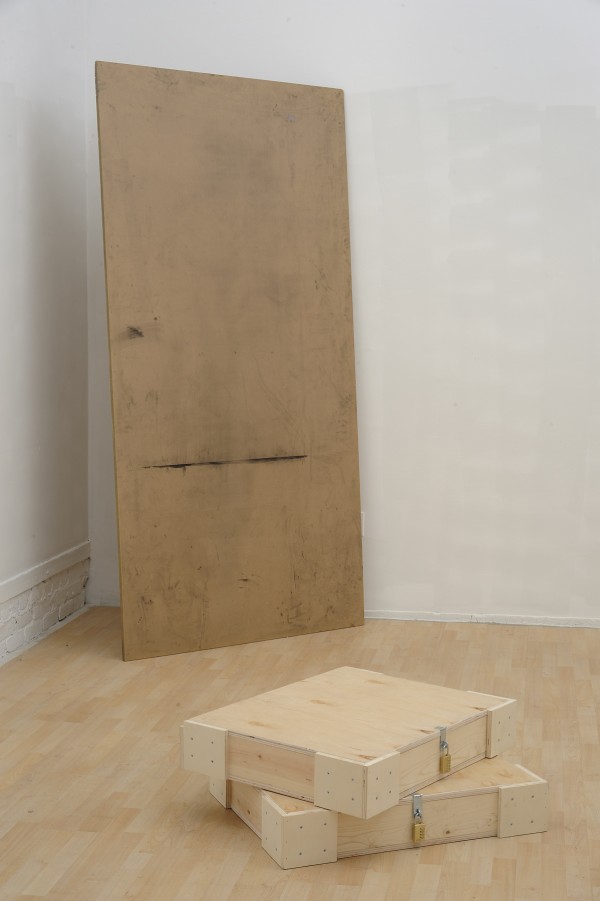
Inside the gallery, the installation is seductively minimal and almost entirely monochromatic. Extracted pieces of Kraus’s studio walls hang mounted in frames, the dry-wall marked with the charcoal smudges and traces of the artist’s process. A large-format, b&w photograph titled An Empty Space documents the void created by hundreds of drawings made on Kraus’s studio wall, where the charcoal that escaped the paper’s surface marks off the edges of the absent pieces of paper. The Serra-esque drawing board learning in a corner reinforces the trompe l’oeil effect of An Empty Space; the two objects acting as the signifier and signified of something that is much more abstract than the expected tangibility of a sign, such as a chair.
The real star of the show, however, is the pairing of two wooden crates locked with combination locks, and a framed envelope that Kraus mailed to Jessica Silverman, the gallery owner. Completely unassuming, the crates (probably) hold all the drawings that we see the traces of in the surrounding works. The corresponding envelope contains the combination that opens the locks on the crates. This is a simple enough concept: there is a lock, and there is a combination that opens the lock. The punch-line is that the two pieces may never be acquired by the same person, ensuring that the drawings will never be revealed. Now, I have to admit that the inner-brat in me loves this restriction. As I see it, basically Kraus is saying, “Oh, you wanted to see the art we’re talking about? Too bad.” Of course, the work absolutely should not be pigeon-holed in the sort of school-yard teasing with which I indulgently associate it. The dialog between the works in the show also heavily references the performative act of making art, emphasizing that the process can hold just as much importance as the final product.
Edits is not a show for anyone looking for an easy entry point or sensational reward from the viewing experience. It is not obvious, and demands that viewers release their typically tight grasp on what part of the art-making process we think should be presented. It is also not overly pretentious; the work does not pretend to be something that it’s not. Instead, Kraus expands the aura of the show through omission, and shows the viewer, “This is what I want you to think about.”
Edits is on view at Jessica Silverman Gallery from 7 September­­–20 October, 2012.