Welcome to fortytwofifty. This is where I will be posting useful photo information I come across during the semester, things like links to photographers' websites, recommended readings, inspiring quotes, and much more.

I hope you will check in often. Look, learn, and enjoy!


Showing posts with label background as frame. Show all posts

Saturday, September 15, 2012

richard avedon . . .


The New Yorker magazine as frame . . .

 John Bayley and Iris Murdoch in London, December 1, 1995. For a Life and Letters piece by Ian Hamilton.

Salman Rushdie in London, September 26, 1994.


Toni Morrison in 2003. For a Profile by Hilton Als
.
The New Yorker has been around since 1925, but didn’t publish a single photograph for its first forty-six years. That changed in 1971, when a tiny photo of a bonnet-clad piglet made an appearance on page 64 of the issue of January 30th. Twenty-one more years passed until the magazine took on its first staff photographer: Richard Avedon.
“When Tina Brown brought him to The New Yorker, in 1992,” Adam Gopnik wrote in his 2004 Postscript on Avedon, “she was rupturing a long-standing taboo against photography, and even those who loved his work must have had their doubts. But his photographs, in their epigrammatic compression of a whole subject into a single black-and-white image, were New Yorker profiles in miniature, and within weeks it was as if he had always graced these pages.”
Two years ago, The New Yorkers embrace of photography expanded to include Photo Booth—the blog you’re looking at now—and today we’re introducing a new design for Photo Booth, including a new fullscreen slide-show function. (Just click on the red arrows arrows3.jpg in the upper right corner.) In celebration of our renovation, here’s a look back at Avedon’s portraits of writers commissioned by The New Yorker, including the portrait of Salman Rushdie that appears in our current issue, alongside Rushdie’s account of his life after the fatwa. “A portrait is not a likeness.” Avedon wrote in his book “In the American West.” “There is no such thing as inaccuracy in a photograph. All photographs are accurate. None of them is the truth.”


Read more http://www.newyorker.com/online/blogs/photobooth#ixzz26ZI4xyfn

process and frames . . .


Nope.


Nope.
One of my favorite occurrences in the Art world is when an artist acknowledges the viewers’ expectations, and actively denies them. In a time seemingly ruled by art with the highest sensational value, I can’t help but root for the heroic and/or obstinate people unabashedly making minimalist conceptual art that allows for none of the easily digestible catharses one might hope for. This is not to say that the work is underdeveloped or shallow; I think a closed door holds as much if not more mystery, potential narrative and freedom to expand upon than an open door through which we can clearly see everything. It is the same “closed door” potential that completely saturates Edits, the current exhibition of Jason Kraus’s work at Jessica Silverman Gallery.
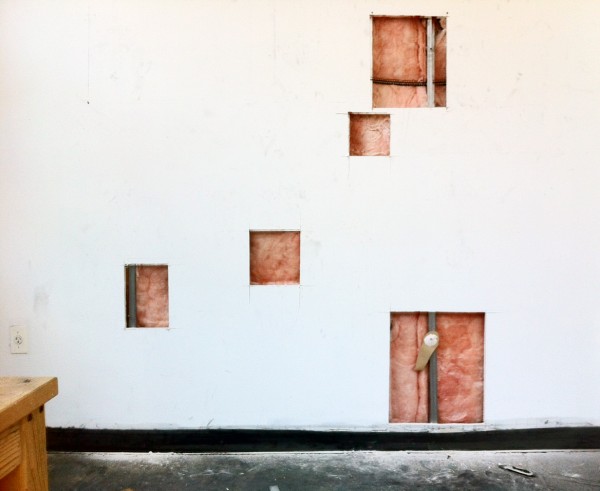
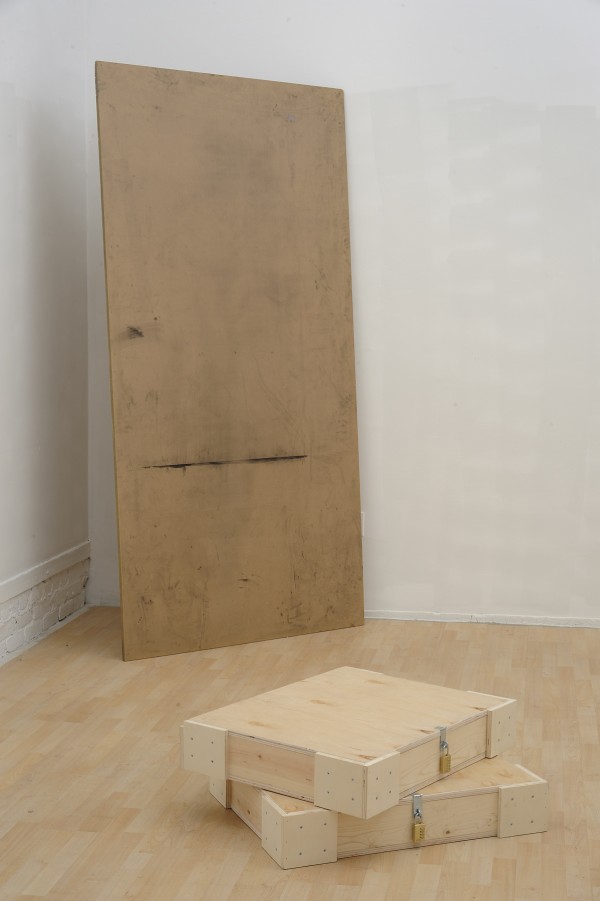
Inside the gallery, the installation is seductively minimal and almost entirely monochromatic. Extracted pieces of Kraus’s studio walls hang mounted in frames, the dry-wall marked with the charcoal smudges and traces of the artist’s process. A large-format, b&w photograph titled An Empty Space documents the void created by hundreds of drawings made on Kraus’s studio wall, where the charcoal that escaped the paper’s surface marks off the edges of the absent pieces of paper. The Serra-esque drawing board learning in a corner reinforces the trompe l’oeil effect of An Empty Space; the two objects acting as the signifier and signified of something that is much more abstract than the expected tangibility of a sign, such as a chair.
The real star of the show, however, is the pairing of two wooden crates locked with combination locks, and a framed envelope that Kraus mailed to Jessica Silverman, the gallery owner. Completely unassuming, the crates (probably) hold all the drawings that we see the traces of in the surrounding works. The corresponding envelope contains the combination that opens the locks on the crates. This is a simple enough concept: there is a lock, and there is a combination that opens the lock. The punch-line is that the two pieces may never be acquired by the same person, ensuring that the drawings will never be revealed. Now, I have to admit that the inner-brat in me loves this restriction. As I see it, basically Kraus is saying, “Oh, you wanted to see the art we’re talking about? Too bad.” Of course, the work absolutely should not be pigeon-holed in the sort of school-yard teasing with which I indulgently associate it. The dialog between the works in the show also heavily references the performative act of making art, emphasizing that the process can hold just as much importance as the final product.
Edits is not a show for anyone looking for an easy entry point or sensational reward from the viewing experience. It is not obvious, and demands that viewers release their typically tight grasp on what part of the art-making process we think should be presented. It is also not overly pretentious; the work does not pretend to be something that it’s not. Instead, Kraus expands the aura of the show through omission, and shows the viewer, “This is what I want you to think about.”
Edits is on view at Jessica Silverman Gallery from 7 September­­–20 October, 2012.

Monday, September 10, 2012

yayoi kusama . . .

No photographs here, but very visually compelling presentation of dots! maybe think photographs??


LUDWIGSHAFEN.- Visitors adhere circular stickers in a room installation at the exhibition “Dot.Systems - from Pointillism to Pixel” by Japanese artist Yayoi Kusama at the Wilhelm-Hack Museum in Ludwigshafen, Germany. Tthe exhibition which will run until Sept. 30, the room was absolutely white. The installation was created by all the visitors who attached the colorful stickers. AP Photo/dapd, Torsten Silz.


Thursday, September 6, 2012

rafael lozano-hemmer . . .


Rafael Lozano- Hemmer
Voice Array
Sep 6 – Oct 13, 2012 bitforms gallery nyc


bitforms gallery is pleased to announce its fourth solo exhibition with Mexican-Canadian artist Rafael Lozano- Hemmer. The exhibition features the United States premiere of two projects: Voice Array, a participatory environment that debuted last Fall in Sydney, Australia, at the Museum of Contemporary Art; and Last Breath, which was part of the 11th Bienal de la Habana. Concurrent with the New York exhibition, on September 20, Lozano-Hemmer will also unveil Open Air, a new commission by the Association for Public Art in Philadelphia.
Since his emergence in the 1990s, Lozano-Hemmer has mixed the disparate fields of digital media, robotics, medical science, performance art, and lived experience into interactive artworks. Probably best known for his large-scale “Antimonuments”, which challenge traditional notions of site-specificity, he focuses on the idea of creating relationship-specific work through connective interfaces. Often employing vanguard technologies, many of his projects utilize robotics, custom software, projections, internet links, cell phones, sensors, LEDs, cameras, and tracking systems.
The communal spaces that Lozano-Hemmer creates are an experiment in public authorship. Technology in his work activates seamless “encounters of art, self and the kinetic force of collective memory,” writes Claudia Arozqueta (Artforum.com, Jan 2012). As a conductor of this experience, he seduces the audience into participation, using tactile sensation, repetition and the simulated presence of an individual.
At the gallery entrance, Last Breath is a robotic installation that stores and circulates the breath of a person forever, between a bellows and a brown paper bag. The apparatus is automatically activated 10,000 times per day, the typical respiratory frequency for an adult at rest. With each breath the piece generates quiet sounds from the bellows, the motor and the crackling of the paper bag. The piece also sighs 158 times a day. For the exhibition in New York, the piece is a biometric portrait of Cuban singer Omara Portuondo. A short video of her recording her breath into the device is shown on a small screen mounted to the wall.
Filling the gallery’s far wall, Voice Array is a construction for vocal improvisation that uses blinking LEDs and a customized intercom system of audio playback and recording. Capturing hundreds of voices and translating each one into a series of light flashes, the piece stores a unique pattern as a loop in the first light of the array, until the next participant speaks into the intercom. Each new recording is pushed along its long horizontal band of LEDs, as sounds of the voices gradually accumulate. When the first voice reaches the other side of the piece, the participant’s phrase is once again released as sound, punctuated by the staggering pulsation of all the lights in tandem. The ever-changing voices stored by the piece play back through a directional speaker, during moments of less activity. 

Click here to read and see more.

Wednesday, July 25, 2012

andy freeberg . . .

In Andy Freeberg's series Art Fare, the art on display becomes a frame, creating an accidental "living diorama."


"Gallery owners and their staff are usually hidden behind large entry desks and closed office doors. But at the major art fairs I've visited, like New York's Armory Show and Art Basel in Miami and Switzerland, they're in plain view in their booths. As if on stage, you can see art dealers meeting with collectors, selling and negotiating, talking on cell phones, working on laptops, and manipulating touch screens in 21st century postures newly adapted for the latest electronic devices. I found the lighting, costumes, and set design excellent for photographing these living dioramas, where the art world plays itself." Andy Freeberg


To see more of Andy Freeberg's work click here.


Sean Kelly

Spinello

Andrea Rosen

Gagosian

Leonard Ruethmueller

Rokeby

Tuesday, July 24, 2012

magnum contact sheets . . .

Magnum Contact Sheets reveals how Magnum photographers have captured and edited their best shots from the 1930s to the present. The contact sheet, a direct print of a roll or sequence of negatives, is the photographer's first look at what he or she has captured on film, and provides a uniquely intimate glimpse into their working process. It records each step on the route to arriving at an image—providing a rare behind-the-scenes sense of walking alongside the photographer and seeing through their eyes. Including both celebrated icons of photography and lesser-known surprises, the exhibition functions as an "epitaph" to the contact sheet, now rendered obsolete by digital photography. Through these fascinating and usually private images, the exhibition celebrates what and how photographers saw for nearly a century. Coinciding with the publication of Magnum Contact Sheets (Thames & Hudson), edited by ICP Curator Kristen Lubben, the exhibition includes a selection of some of the 139 contact sheets in the book.
This exhibition was made possible with public funds from the New York City Department of Cultural Affairs in partnership with the City Council. It is organized in association with Magnum Photos.


Sunday, July 22, 2012

angelica dass . . .


Humanae  is a chromatic inventory, a project that reflects on the colors beyond the borders of our codes by referencing the PANTONE® color scheme.(PANTONE® Guides are one of the main classification systems of colors, which are represented by an alphanumeric code, allowing to accurately recreate any of them in any media. It is a technical industrial standard often called Real Color)The project development is based on a series of portraits whose background is dyed with the exact Pantone® tone extracted from a sample of 11x11 pixels of the portrayed’s face. The project’s objective is to record and catalog all possible human skin tones.
Click here to read more about this project.